For radio masts, telecommunication towers or data centres, a reliable power supply in case of a power failure/blackout is essential to ensure the continued operation of the equipment. EFOY Hydrogen fuel cell solutions as well as EFOY Pro methanol fuel cells are also used for power supply in large-scale emergencies. For example, for emergency equipment and as on-board power supply for the vehicles of emergency and blue light organisations.
| Power requirement | Between 1 and 50 kW |
| Application requirements | Stationary as back-up power supply, emergency power supply system, on-board power supply or mobile for temporary use on site |
A minute can become an eternity; it’s just a question of perspective. Especially when it counts. A diesel generator takes a minute or more to provide emergency power to critical infrastructure in the event of a disaster – an eternity. In large-scale emergencies resulting from floods, hurricanes or earthquakes, disaster control forces must quickly gain an overview of the situation and gather information. Communication is a success factor for effective emergency measures on the ground. However, disasters are often accompanied by power outages or emergency forces have to operate in regions far from the power grid. A fast, efficient and sustainable energy supply is essential. For civil protection forces, hydrogen and fuel cell technology offer new possibilities and numerous advantages for a reliable power supply during operations.
Climate-neutral, uninterruptible, flexible – EFOY Hydrogen energy solutions with hydrogen fuel cells make the difference and are an indispensable energy source in disaster control up to 50 kW, whether stationary or mobile.
EFOY Hydrogen energy solutions can be used both stationary and mobile. The EFOY H₂Cabinets are turnkey control cabinet solutions for use in stationary applications and the H₂Genset is a flexible and mobile power generator with hydrogen fuel cells for areas without access to the conventional power grid.
EFOY Pro methanol fuel cells are the ideal power generators for a variety of stationary and mobile applications in the power range up to 3 kW and reliably generate electricity for weeks and months without user intervention.
EFOY H₂Cabinet – Stationary up to 50 kW
By loading this YouTube Video you agree to the terms of services and privacy policy of Google.

Blue light organisations mainly use the EFOY Pro Fuel Cell, e.g. in Fire brigade vehicles. With the EFOY Pro, the entire vehicle electronics can be powered sustainably when the vehicle is at a standstill with the engine switched off. Numerous federal and law enforcement agencies in Europe and North America use the EFOY Pro fuel cell as a mobile power supply for office equipment and covert surveillance.
100% reliable
Power supply during use is ensured thanks to the EFOY Fuel Cells. The fuel cell works in any weather, day and night, as well as in any season.
Quiet and environmentally friendly
Thanks to environmentally friendly power generation, the EFOY Fuel Cells can be used in nature reserves as well as in closed vehicles and rooms.
Cost savings
EFOY Fuel Cells reduce maintenance and operating costs through battery charge conservation and significantly reduce engine operating hours.
No detectable signature
The EFOY Fuel Cell recharges the on-board battery in the vehicle fully automatically, quietly and undetectably. It ensures the operation of consumers even when the engine is switched off, thus maintaining the camouflage.
Low fuel consumption
EFOY Fuel Cells consume less fuel than diesel generators due to the high efficiency and energy density of methanol. This ensures a significantly longer autonomy without user intervention for fuel refilling.

“Uninterrupted operation”
The uninterrupted operation, the reliability and the low maintenance costs are decisive for our customers.
Gernot Mariacher, Wolftank
Find the right model
Your continuous output requirement

EFOY Pro 900

EFOY Pro 1800
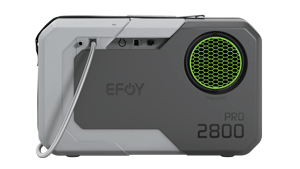
EFOY Pro 2800

EFOY Pro 12000 Duo

EFOY Hydrogen 2.5

EFOY H2PowerPack X50

EFOY 80

EFOY 150
With 2x M28 fuel cartridges (incl. Fuel Manager FM2). The self-sufficiency time can be extended with the use of additional fuel cartridges.
With 2x MT60 fuel cartridges (incl. Fuel Manager FM2). The self-sufficiency time can be extended with the use of additional fuel cartridges.
With 12x H2 bottles (300 bar). The back-up hours can be extended with the use of additional H2 bottles.
EFOY Energy Solutions in use
EFOY Fuel Cell Energy Solutions are used in many applications and provide environmentally friendly and reliable power. Fuel cells are used both as a mobile solution and for hard-to-reach and remote locations without access to the stationary power grid.
Read some of our reference reports and how our customers have solved the issue of self-sufficient power supply with EFOY.